
Demo 001 — Our First Magic
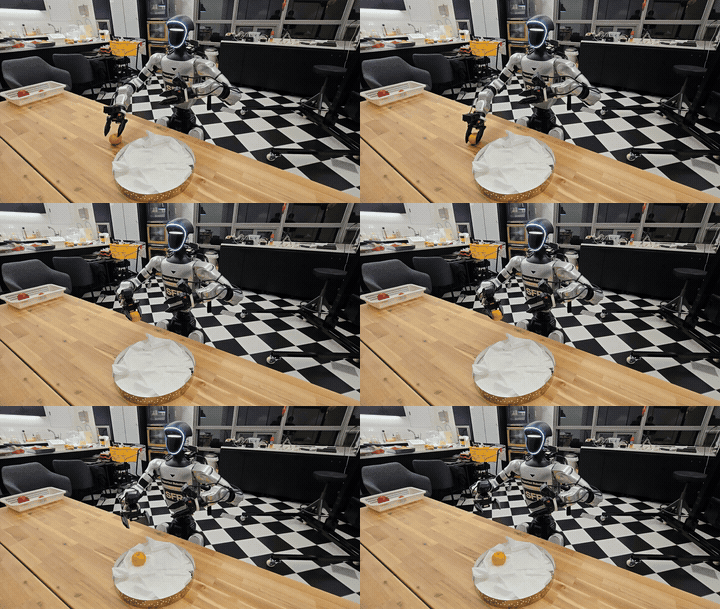
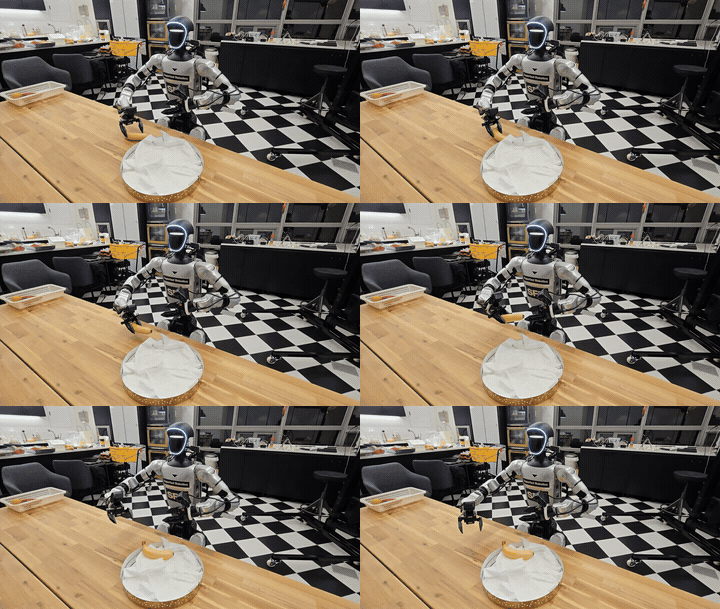
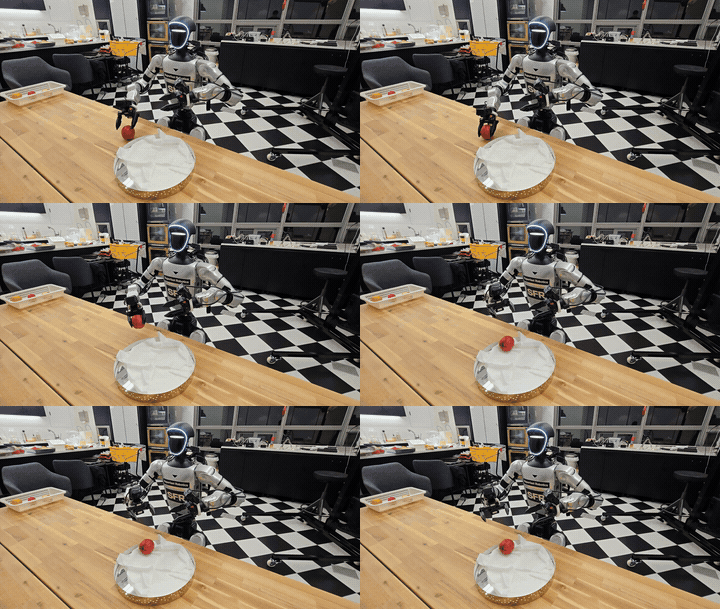
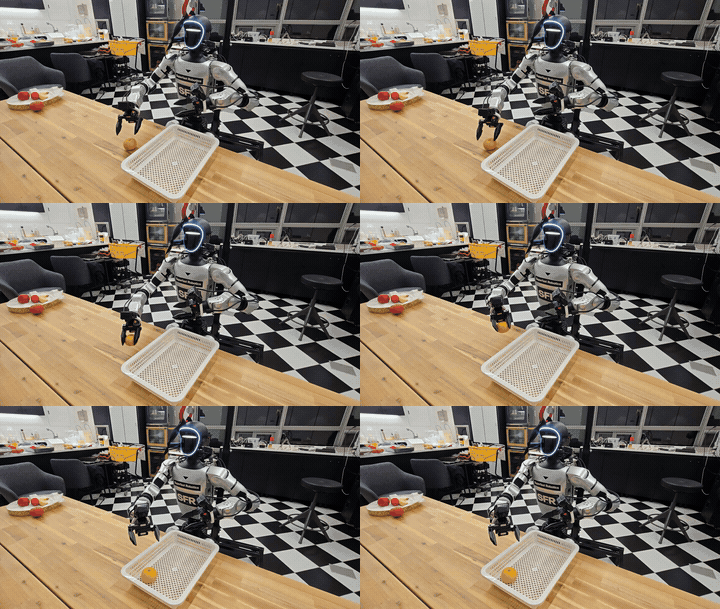
“Put the fruit in the basket.”
- Platform
- Jetson Orin NX
- Memory
- 16 GB shared
- Task
- Fruit pick-and-place
The task
Six words. Plenty can go wrong.
A robot has to find the fruit, decide where to move its hand, reach, grasp, carry, and release. If it misses, it has to try again. Now ask it to do all of this using the small computer inside its body.
We added one more constraint: compress the language-model backbone by 160x.
That sounded a little unreasonable. So we tried it.
Could not open full screen. Please use the video player's controls.
Model & setup
We started with Unitree’s 6B-parameter UnifoLM-WLA-1.0. We took the sub-1-bit methods we had researched at Samsung Research, improved them, and applied them to its language-model backbone.
The compressed weight representation uses roughly 1/160 of the bits required by FP16. Less than 1%. This does not mean we deleted 99% of the entire 6B model. We packed a core part of its decision-making into much less space.
All inference ran on the robot’s onboard NVIDIA Jetson Orin NX, with 16 GB of shared memory. There was no large server offscreen deciding its next move.
For compression training, we used FruitCollection from the WLA training data and QAKD to transfer the original model’s behavior. We connected the model to the robot with our preliminary custom IK solver: the part that turns a desired hand position into joint movements.
This was an early checkpoint. We had completed less than 10% of the planned training. We had also left out RTC, which could make the motions flow more smoothly. There was plenty left to improve. We put the robot in front of the table anyway.
Kitchen
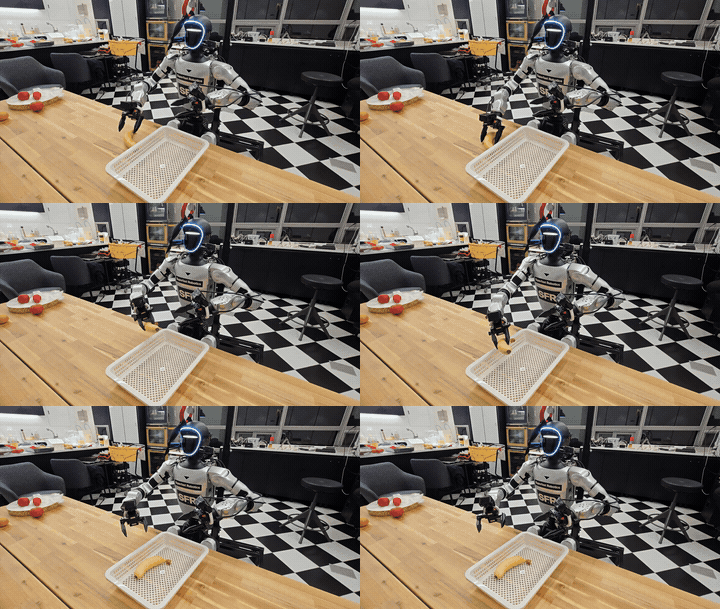
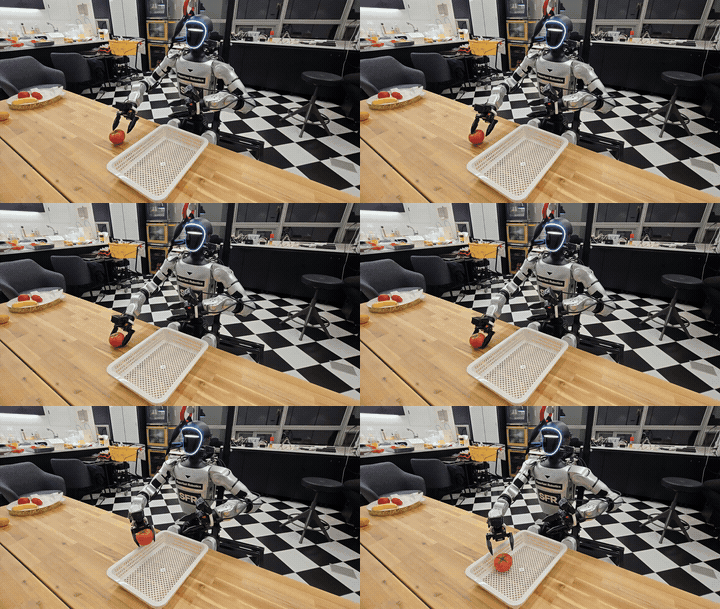
Meeting room
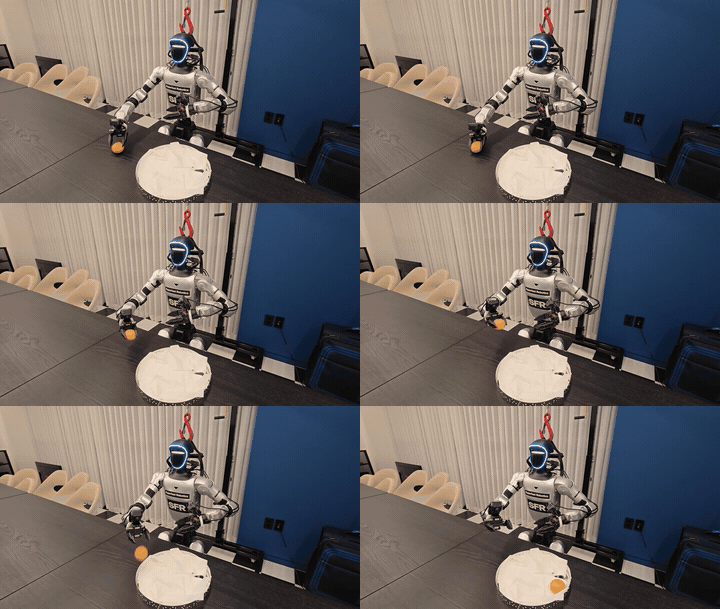
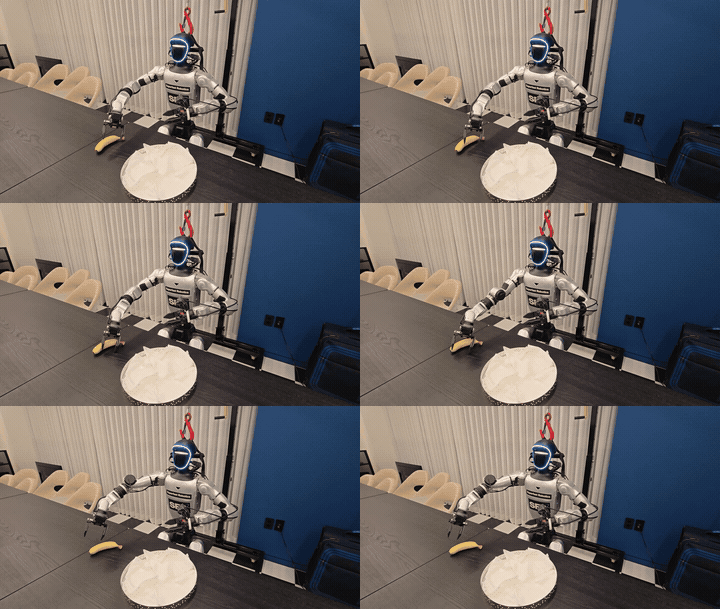
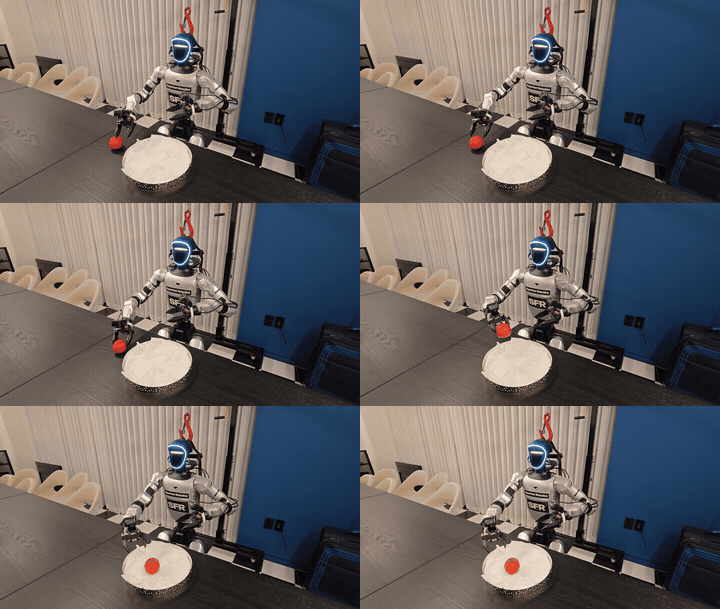
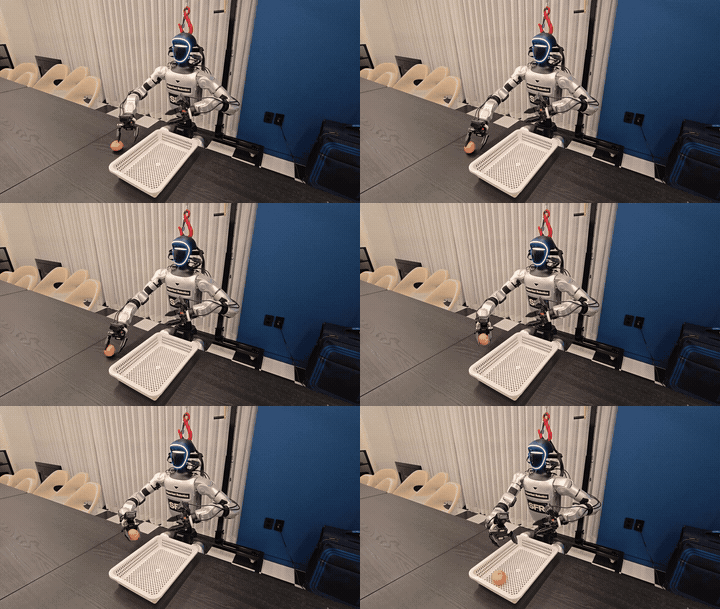
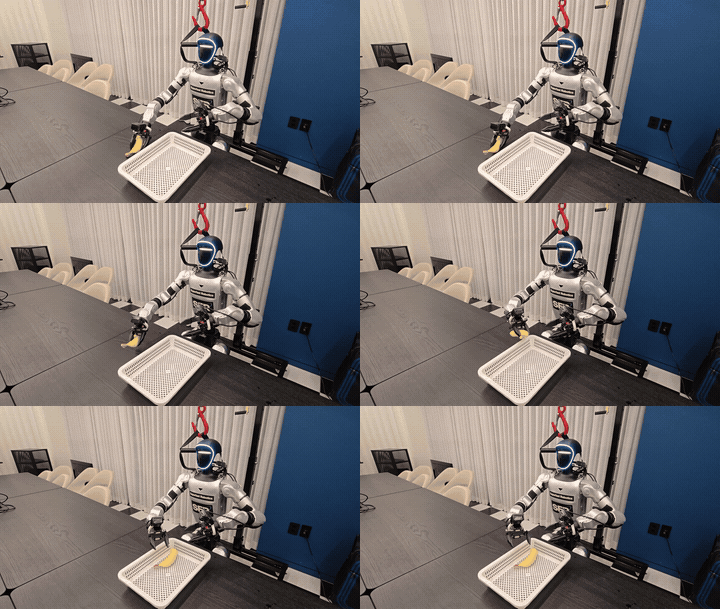
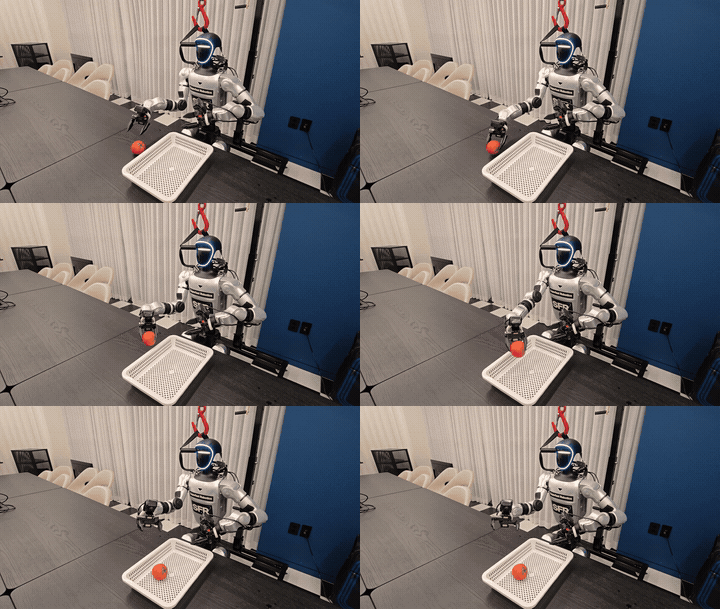
Warehouse
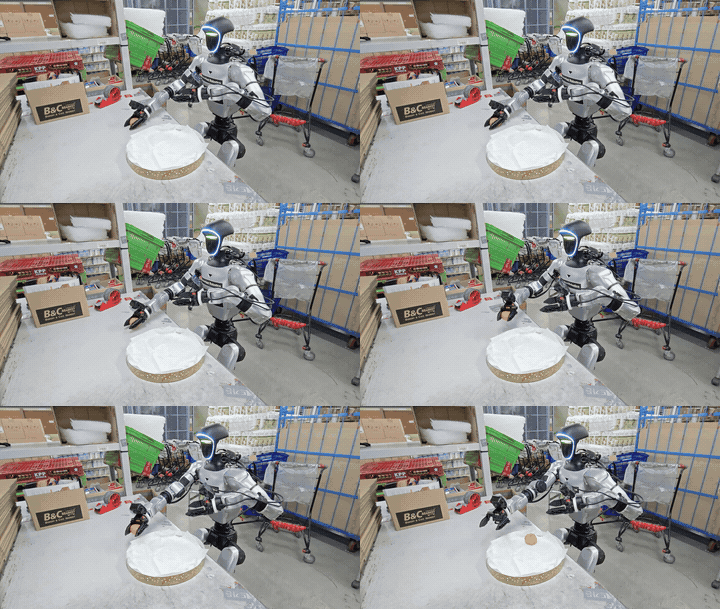
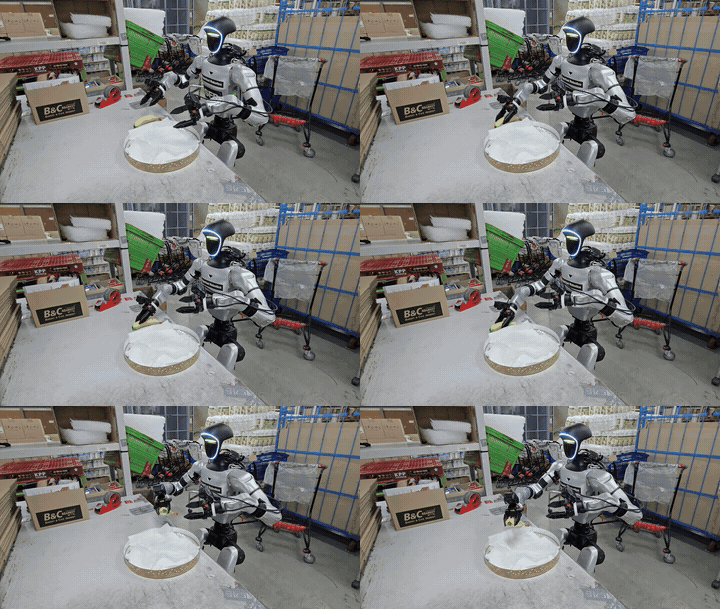
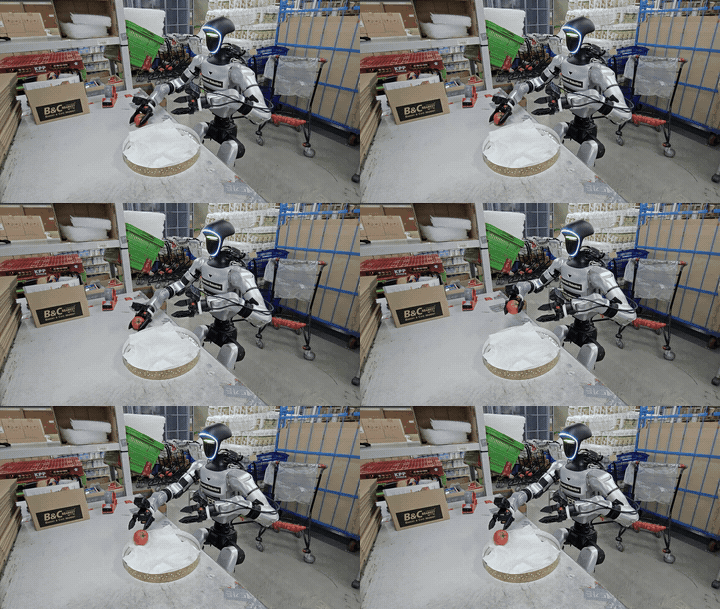
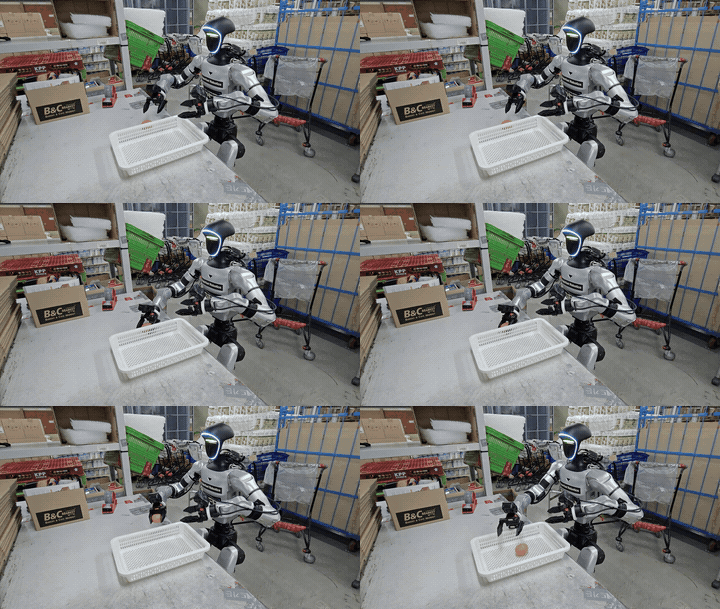
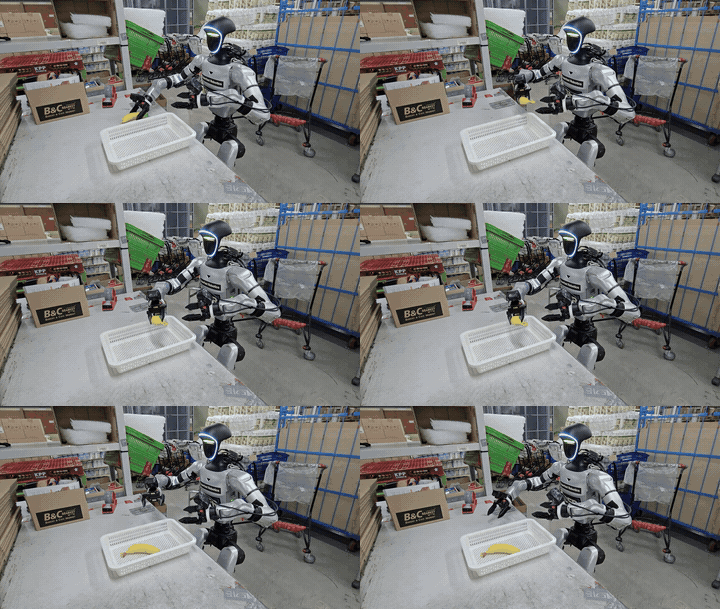
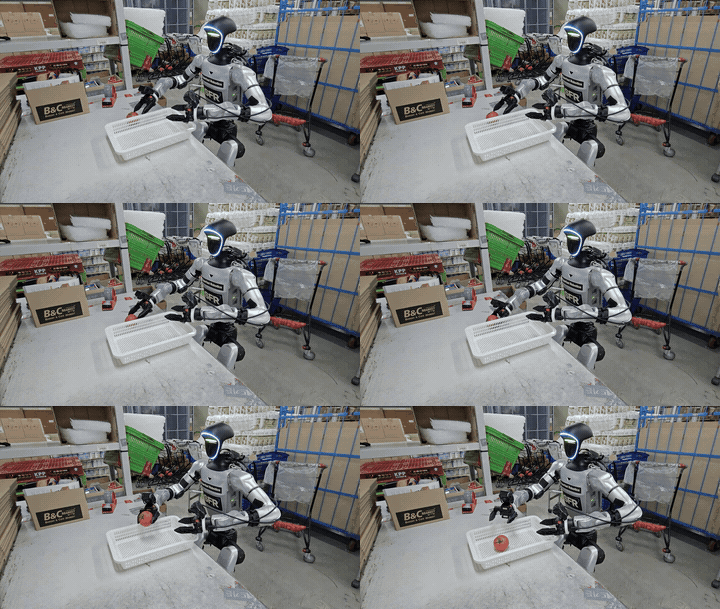
Trial results
We tested in three places: a kitchen, a meeting room, and a warehouse. We used three objects: a tangerine, a banana, and a tomato. And two basket shapes: round and rectangular.
3 locations × 3 objects × 2 baskets × 5 trials each. 90 trials in total.
Each trial started from the home pose and ran for one minute, allowing the robot to recover and retry on its own as it attempted the pick-and-place task. We did no additional training for the evaluation locations or layouts. That is what zero-shot means here: deployment into these new setups. The fruit-moving task itself was already represented in FruitCollection.
The result: 60 successful trials out of 90. A 66.7% success rate.
| Breakdown | Condition | Successes / Trials | Success Rate |
|---|---|---|---|
| Location | Kitchen | 22 / 30 | 73.3% |
| Meeting room | 18 / 30 | 60.0% | |
| Warehouse | 20 / 30 | 66.7% | |
| Object | Tangerine | 24 / 30 | 80.0% |
| Banana | 11 / 30 | 36.7% | |
| Tomato | 25 / 30 | 83.3% | |
| Basket | Round | 31 / 45 | 68.9% |
| Rectangular | 29 / 45 | 64.4% | |
| Overall | All conditions | 60 / 90 | 66.7% |
The location, object, and basket breakdowns are different views of the same 90 trials.
Bananas were hard. Eleven successes out of thirty. We have learned how to get down to 0.1 bits. We still have some learning to do about picking up bananas.
We look at these numbers and see work ahead. Thirty trials failed. We need more objects, more environments, and direct comparisons with the original model.
But we have a starting point. A model whose compressed backbone weights use less than 1% of the FP16 bit budget looked at a new setup, chose its next actions, and moved a real object. On a computer inside the robot.
That was our first bit of magic.
What comes next
We have nearly used up the resources we set aside for this first step. There are plenty of experiments left. We want to train further, improve control, and make this work on more robots. We want to turn the research into products people can use.
If you want to see what comes next, help us build it. We welcome research funding, robots to test on, and partners who want to bring this technology into real products.
Our goal is a robot with System 0, 1, and 2 all running on an Orin-class onboard computer: fast control of its body, immediate responses to what it sees, and planning for what to do next. All inside one robot, working independently of the network, doing useful things in our lives.
Today, it moved a piece of fruit.
We intend to find out how far this little beginning can go.
Superfast.
References
- Unitree Robotics. UnifoLM-WLA-1.0. Official model and code repository.
- Banseok Lee, Dongkyu Kim, Youngcheon You, and Youngmin Kim. LittleBit: Ultra Low-Bit Quantization via Latent Factorization. NeurIPS, 2025.
- Banseok Lee and Youngmin Kim. LittleBit-2: Maximizing the Spectral Energy Gain in Sub-1-Bit LLMs via Latent Geometry Alignment. ICML, 2026.
- NVIDIA. Jetson Orin NX Series. Module specifications.
Citation
Download .bib@article{sfr2026demo001,
author = {{Superfast Robotics}},
title = {Demo 001 — Our First Magic},
journal = {Superfast Robotics Writings},
year = {2026},
note = {superfastrobotics.com/writings/demo-001},
}